
Meta Ads vs. Boosting Posts

Why Most Brands Are Confusing Visibility With Real Growth
A data backed look at why these two tools produce completely different results, what the industry’s best campaigns actually deliver, and how to structure ads that build a business instead of just buying visibility.

One of the biggest misconceptions I see from creators, influencers, and businesses trying to scale online is believing that boosting a post and running a Meta ad campaign are essentially the same thing. They are not. Not even close. And honestly, that confusion is exactly what Meta wants, because boosting is the easiest way for them to monetize content while requiring almost no real understanding from the brand running it.
Meta has intentionally made boosting content feel simple and accessible. You click a button. You choose a budget. You select an audience. You hit boost. Suddenly, your content is being shown to more people. On the surface, it feels productive. Engagement increases, views rise, followers come in, and for a moment, it feels like the content is working. Now giving it credit its not money lost, but it’s not the best route for longevity. Listen to me closely, I have done it, and it is not say I won’t do this at some point or other I just understand the difference.
Visibility and scalable business growth are not the same thing, and understanding that distinction changes the way you approach marketing entirely. I often find myself in conversations of the options we offer that hit both quick conversion and options that play the long game.
I think social media has conditioned businesses to celebrate the easiest metrics to measure because those metrics provide immediate validation. The views look impressive. Viral reels feel exciting. High engagement creates the illusion of momentum. But one of the most common frustrations I hear from brands after boosting posts is that despite all the activity, they are not seeing measurable business growth. Engagement spikes briefly. Then conversions stay inconsistent. Website traffic does not sustain. Revenue growth feels unpredictable. The problem is not necessarily that boosting posts is ineffective. The problem is that most businesses are using awareness tools while expecting conversion results.
There is a massive difference between someone casually liking a reel while scrolling and someone intentionally clicking through to shop an LTK Post, browse an Amazon storefront, join an email list, book a service, or purchase a product. Those are entirely different user behaviors, and Meta’s advertising platform treats them very differently depending on how campaigns are structured.
Boosting a post is designed primarily around expanding visibility and engagement. Running a true Meta ad campaign inside Ads Manager is designed around understanding audience behavior, conversion patterns, and long term scalability. One approach amplifies content. The other builds infrastructure behind a business. That difference becomes even more important the moment a brand starts scaling, because the systems behind your ads start determining whether your growth compounds or quietly stalls.
What the Numbers Actually Say in 2026
Before we go deeper into strategy, it helps to understand what realistic Meta advertising performance actually looks like in 2026, because most brands have no real benchmark for what good even is. According to the most recent published industry data from WordStream, LocaliQ, and Triple Whale, the baseline looks like this:
- The average click through rate across all Meta ad campaigns is approximately 1.86%
- For traffic focused campaigns specifically, the industry average sits around 1.71%
- For lead generation campaigns, the average climbs to 2.59%, the highest of any objective.
- Even the top performing industry verticals (Shopping, Collectibles, and Gifts) cap out around 4.13% CTR.
- The median CPM across all industries is approximately $13.48.
These are the realistic numbers most businesses should expect when running ads without a deeply structured campaign strategy. Anything significantly above these benchmarks is being driven by infrastructure that goes well beyond what boosting a post can ever achieve. And once you understand the industry floor, you also begin to understand why the difference between average campaigns and top performing campaigns has almost nothing to do with the platform itself. It has everything to do with the strategy and execution behind it.
Why Spending More Money Does Not Fix Weak Marketing
One of the biggest mistakes I see businesses make is assuming that spending more money automatically fixes weak marketing. It does not. Throwing larger budgets behind content without a strategy simply accelerates inefficiency. Strong advertising is not built on random visibility. It is built on understanding who your audience is, how they behave, what makes them convert, what creative resonates with them, and how to continuously optimize campaigns as performance data comes in.
This is where most businesses realize that running ads involves far more than simply selecting an audience and uploading a photo. There is an entire operational layer underneath every successful campaign that goes completely unseen by people scrolling through their feeds, and that operational layer is the actual difference between a brand that grows predictably and a brand that survives off of occasional viral moments.
I see it firsthand, our work goes far beyond managing ads at the surface level. We manage, curate, implement, monitor, and analyze campaigns from initial strategy all the way through achieving measurable business goals, because successful campaigns require much deeper operational strategy than most people realize. Every brand has a completely different customer journey. A fashion creator audience behaves differently than a med spa audience. An affiliate campaign performs differently than a service based lead generation campaign. The psychology behind why someone clicks, shops, converts, or returns is never identical across industries, which is exactly why campaign strategy cannot be treated as one size fits all.
What Actually Happens Behind the Scenes
A huge portion of successful advertising actually happens behind the scenes where most businesses never see it. Audience research, retargeting structure, conversion tracking, spend pacing, creative testing, copy refinement, analytics monitoring, funnel mapping, and optimization cycles are what ultimately determine whether campaigns become profitable long term or simply generate temporary engagement spikes.
We ensure our ad management structure includes account audits, ad readiness reviews, funnel mapping across awareness and conversion stages, audience research, copy development, headline testing, campaign buildouts, optimization, analytics reviews, scaling strategy, and conversion tracking, because scalable growth requires infrastructure behind the content itself. Also, what our client gets excited to tall about and where they find success without even pushing an ad. This is important, it’s what makes them authentic and tapping into the community of selling, not just a quick sale. None of those things happens when a brand simply boosts a post. They cannot. The tools are not even available inside the boost interface. That is not a limitation you can work around. It is the core of why boosting and ad management produce fundamentally different outcomes.
The Difference Between Boosting and Strategic Ads at a Glance
Before we get into case studies and creative strategy, it helps to actually see the distinction laid out side by side, because most brands have never had this explained to them clearly.

What Happens When Strategy Meets Infrastructure
One of the most interesting things we consistently see managing campaigns is how dramatically performance changes once campaigns are structured around audience behavior instead of surface level engagement. The same brand, the same creative, the same offer, run inside a properly built campaign structure with audience research behind it, can produce results that look nothing like what they saw when they were boosting posts.
The campaigns we manage at Parlay Collective consistently run between 8 and 11 % click through rate. That is roughly 5x the industry average and more than 2x the top performing industry verticals.
That is not luck. It is not a one-off result. It is the outcome of a structured campaign infrastructure applied consistently across budgets, audiences, and objectives. Below are three real case studies showing what that looks like in practice.


Why Consistency at Scale Matters More Than Initial Performance
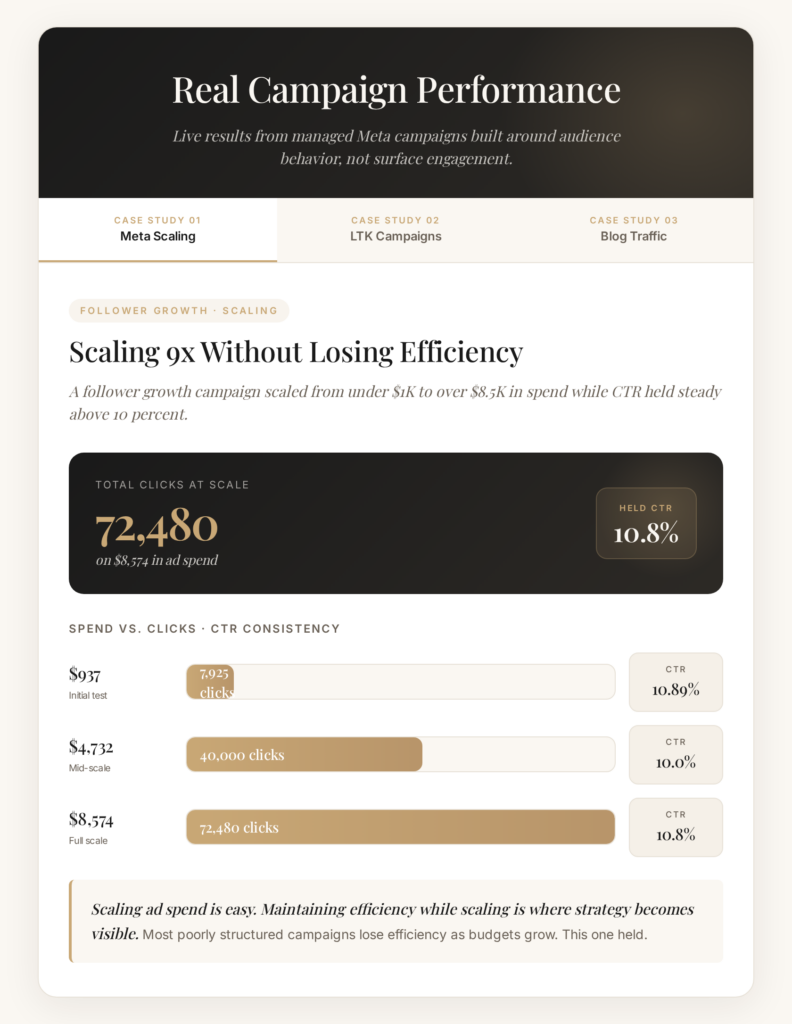
That consistency matters because most poorly structured campaigns become significantly less efficient as budgets increase. Scaling ad spend is relatively easy. Anyone can spend more money. Maintaining efficiency while scaling is where actual strategy becomes visible.
In one of our follower growth campaigns, a spend of just under $1,000 generated more than 72,000 impressions and nearly 8,000 clicks while maintaining a click through rate above 10 percent. What became even more important was that scaling the campaign to over $8,500 in spend still maintained nearly identical efficiency metrics while generating more than 665,000 impressions and over 72,000 clicks. That is the kind of result that simply does not happen without structured strategy underneath it.
This is also why I think so many businesses misunderstand what makes advertising successful in the first place. They focus heavily on content creation while underestimating the infrastructure required behind distribution. Great creative absolutely matters, but distribution strategy determines whether that content actually reaches the right audience consistently.
Organic reach alone is no longer predictable enough to sustain long term growth for most brands. Algorithms shift constantly, audience behavior changes rapidly, and relying entirely on organic visibility creates unstable growth patterns that many businesses eventually struggle to maintain. That does not mean organic content is unimportant. In fact, strong organic content is usually the foundation of successful advertising, because high performing content gives valuable insight into audience behavior. One of the smartest strategies brands can implement is identifying which content naturally resonates with audiences first, then strategically amplifying and scaling that content through advertising infrastructure. Ads work best when they are supporting proven content instead of trying to force weak content to perform.
The Creative Format That Actually Performs on Meta
One of the things most brands skip over entirely is choosing the right creative format for the campaign objective. Boosting trains you to think of one post and one format at a time. Strategic advertising treats creative as part of a system, where format, content, and message work together based on what you actually want the audience to do. Format is not a stylistic decision. It is a strategic one.
Reels and Short Form Video
Short form video remains the strongest creative format on Meta in 2026, and Reels specifically are where the algorithm is still aggressively pushing reach. Video works best for awareness, follower growth, engagement, and storytelling driven affiliate content. It is the format that builds trust the fastest because audiences see your face, hear your voice, and connect with the moment. For creator led brands, LTK campaigns, and lifestyle storefronts, native style Reels almost always outperform polished branded video. The reason is intent alignment. The audience is on the platform to consume creator content, and creator content is what they trust enough to actually click on.
Carousels
Carousels are one of the most underused formats inside Ads Manager, especially for affiliate, LTK, and Amazon storefront campaigns. They give you multiple swipeable slides, which means you can show multiple products, multiple use cases, multiple price points, or build out an entire visual story in a single ad unit. Carousels reward audiences for engaging longer, which Meta rewards back with stronger placement. If you are running a curated shop, a seasonal edit, a multi product launch, or a gift guide, the carousel is almost always the right call.
Single Image Ads
Single image ads are not dead, despite what most marketers say. They are simply being used incorrectly. The single image format performs strongest in two specific scenarios. The first is conversion campaigns with a clear hero product, a strong offer, and a known audience. The second is retargeting campaigns where the audience already knows your brand and just needs a reminder to come back and finish what they started. Clean, editorial, lifestyle driven single images can outperform video in retargeting because the visual recognition is faster.
Text Overlay and Hook Cards
Text overlay is a tool, not a default. Used well, it can stop the scroll and frame the message in the first second of the ad. Used poorly, it makes the content feel like a marketing template that audiences immediately filter out. The rule I follow is that text overlay should always feel like it belongs in the visual, not stamped on top of it. Editorial typography. Brand aligned color. Short and punchy phrases. If your text overlay looks like a meme template, it is hurting performance more than helping.
Creator Style vs. Branded Style
The single biggest creative shift I have watched happen on Meta is the move away from polished corporate looking creative toward content that feels like it was made by a real person. Creator style ads outperform branded style ads in nearly every category we manage, especially in fashion, beauty, wellness, home, and lifestyle. The reason is that audiences scroll past anything that immediately reads as an ad. They stop on content that feels like a recommendation. That is why structuring ads to feel native to the feed is one of the most important strategic decisions a brand can make in 2026, and it is something boosting cannot replicate because boosting limits creative testing and structure entirely.
What Your Ad Should Actually Say
Creative format is only part of the equation. The verbiage inside your ad, the words on the screen, the words in the caption, the words in your CTA, are what move someone from passively watching to actively clicking. Most brands write ad copy that sounds like marketing. The brands that grow write copy that sounds like trust.
The First Three Seconds Decide Everything
Whether your ad is video, carousel, or static, the first three seconds determine whether the audience continues or scrolls. The hook must do one of three things. It must call out a specific person (“If you’re a creator scaling past a million in revenue…”), name a specific pain point (“If your ads are getting impressions but no real clicks…”), or open with a curiosity loop (“Here is what nobody tells you about boosting posts…”). Vague openings lose. Specific openings convert.
The Middle Builds the Authority
Once the hook lands, the middle of your ad is where you earn the click. This is where most brands either oversell or undersell. The goal is to give one valuable insight, one piece of social proof, or one clear differentiator. Show one real result. Reference one real client. Share one real number. Audiences in 2026 do not respond to vague claims of “transforming businesses” or “elevating brands.” They respond to specifics. The more specific the language, the more credible the brand.
The CTA Is a Verb, Not a Phrase
“Click here” and “Learn more” are the weakest CTAs you can run. They are vague, they do not match the audience’s intent, and they make your offer sound generic. Strong CTAs name the action. “Shop the look on LTK.” “Browse the storefront on Amazon.” “Save your spot for the strategy call.” “Get the free guide sent to your inbox.” “Read the full breakdown on the blog.” The CTA should tell the audience exactly where they are going and exactly what they will get when they get there. In 2026, audiences scroll faster than ever. Specificity is the only thing that earns the stop.
Voice and Tone Are Not Optional
Every ad you run is a representation of your brand voice. If your captions feel different from your reels, your reels feel different from your stories, and your ads feel different from all of it, the audience subconsciously feels the inconsistency. Strong campaigns sound like the founder, the creator, or the brand voice every single time. The verbiage should feel like it was written by a person, not assembled by a marketing department.
What You Are Actually Offering Matters More Than the Ad Itself
A perfect ad with a weak offer will underperform every single time. A simple ad with a strong offer will outperform a perfectly produced one. The offer is the actual reason someone takes action. The offer is what determines whether the audience says yes, and the offer is what most brands underinvest in. Below are the categories of offers that consistently perform inside Meta campaigns, broken down by what works for what audience type.
Lead Magnets and Free Resources
Free guides, checklists, templates, curated edits, gift guides, exclusive access, and educational content remain some of the strongest performing offers on Meta in 2026. Which is kind of shocking to me, but I am a sucker for a good download that cold holds resources I find of value. This content lowers the friction of saying yes, they capture audience data that becomes incredibly valuable for retargeting and email nurture, and they position the brand as a source of expertise before asking for anything in return. Lead magnets work best for service businesses, course creators, and brands building owned audiences.
Direct Product Links
For ecommerce, direct product links remain the most efficient conversion path when paired with strong creative. The offer here is the product itself, ideally paired with a real reason to buy now. A new launch. A limited edition. A seasonal collection. A restock. Urgency, scarcity, and specificity matter more than discounts.
LTK and Amazon Storefront Links
For creator and affiliate driven brands, the storefront link is the offer. The brand is the curator. The audience is buying the taste, the styling, the recommendation. This is why LTK and Amazon storefront campaigns perform so well when structured correctly. The ad is not selling one product. It is selling access to a curated edit that compounds in value the more the audience trusts the curator.
Email List Opt In With a Real Reason
“Join our newsletter” is not an offer. “Get the weekly drop list before it sells out” is. “Be first to access our quarterly seasonal edit” is. Email is one of the most undervalued long term assets a brand can build, and the offer behind the opt in is what determines whether the list actually grows. Specific, exclusive, ongoing value wins.
Service Booking With Clear Outcomes
For service businesses, the offer is not the service. The offer is the outcome. “Book a strategy call” performs better when reframed as “Book a strategy call to map your next 90 days of campaign growth.” Audiences are not buying calls. They are buying clarity, results, and forward motion.
Discount or Promotional Offer
Discounts work, but only when they feel intentional rather than desperate. A first time customer offer. A bundle. A seasonal promotion tied to a real reason. The best performing discount offers also pair with a clear time frame, because urgency without specificity feels manipulative, while urgency with specificity feels real.
Bundles and Curated Collections
Bundling is one of the most powerful and underused offer structures inside Meta campaigns. Bundling lets you raise average order value, simplify the decision for the audience, and tell a stronger creative story. A curated bundle outperforms three individual product ads almost every time, because the audience does not have to make multiple decisions. They are buying a complete experience.
Where Your Ad Should Send Them
The destination of your ad is not an afterthought. It is part of the campaign architecture itself. The wrong destination kills strong creative, wastes high quality traffic, and breaks the conversion chain. Below is how I think about destination strategy by campaign objective and audience temperature.
Owned Platforms vs. Rented Platforms
Whenever possible, ads should drive traffic to platforms you actually own. Your blog. Your email list. Your website. Your customer database. Rented platforms like Instagram or TikTok can shift overnight, and any audience you build inside them can disappear with a single algorithm change. Owned platforms compound over time. The audience grows. The retargeting pixel populates. The email list strengthens. The customer data deepens. Strategically plan your budget to support all, but budget wisely.
Match the Destination to the Intent
Cold audiences need a low friction destination. A blog post. A lead magnet. A short form opt in page. They are not ready to buy yet, and asking them to buy too early breaks trust. Warm audiences (people who have engaged, watched, clicked, or visited) can be sent directly to product pages, sales pages, or booking calendars because they already know the brand. The right destination is always the one that matches where the audience actually is in their decision making process.
Long Form Sales Pages for High Consideration Purchases
If your offer requires real consideration (services, courses, high ticket products, programs), a long form sales page outperforms a short landing page almost every time. The audience needs space to evaluate, ask questions, see testimonials, understand the offer, and feel confident enough to convert. Sending high consideration traffic to a thin product page leaves money on the table.
Calendar Bookings for Service Businesses
For service businesses, the strongest destination is often a direct calendar link. The fewer steps between the click and the booking, the higher the conversion. Pair the calendar with a clear preview of what the call covers and what the audience will leave with. Friction kills service businesses faster than weak ads do.
Email Opt In for Nurture Driven Brands
If the buying decision takes time, the destination should not be a sales page. It should be an email opt in that drops the audience into a nurture sequence designed to build trust before asking for the sale. This is especially powerful for high ticket service brands, education brands, and brands selling considered purchases.
When Instagram Is the Right Destination and When It Is Not
Sending traffic to your Instagram is not automatically wrong. If the goal of your campaign is follower growth, brand familiarity, or expanding your owned social audience, then Instagram is the correct destination. We run follower growth campaigns regularly at Parlay Collective, and they work beautifully when that is the actual objective.
The mistake is using Instagram as your default destination because you have not built anywhere else to send people.
When every ad sends people back to your Instagram, you are paying Meta to deliver an audience you do not actually own. You cannot retarget them with the same precision. You cannot email them. You cannot pull customer data from them. If Meta ever changes the algorithm, restricts your reach, or shuts down your account, that audience disappears overnight.
The strongest brands use Instagram strategically. Follower growth campaigns are intentional. But every other type of campaign sends traffic to platforms the brand actually owns. Blog posts. Email lists. LTK pages. Amazon storefronts. Sales pages. The Instagram audience grows alongside those owned assets, not instead of them.
The fix is not to stop running follower campaigns. The fix is to make sure follower growth is part of a system, not a substitute for one.
Where Tools Like Markable Fit In (and What They Do Not Build)
I get asked about Markable a lot. For anyone unfamiliar, Markable is a platform that helps creators and brands turn their existing social content into shoppable, conversion focused ads. It is a smart tool. It is also a great option for brands that want to drive immediate direct sales from existing high performing content. Honestly, I have real respect for what platforms like Markable have built, because the conversion mechanics are genuinely effective. Let me be clear I am a fan of Markable ads!
But here is where I think most brands miss the bigger picture.
Direct sale tools like Markable are built around direct sales without tapping a following or consumer conversion, when pushing directly to Amazon lists or links. And then the audience interaction ends right there. There is no audience being built. There is no retargeting infrastructure being created. There is no email list being grown. There is no compounding community being developed. The sale happens, and then the brand has to spend again to acquire the next sale, and again to acquire the one after that.
That model is fine if your only goal is short-term conversion. But if your goal is long-term scalable growth, that approach leaves a massive amount of value on the table every single time. We feel doing both is great
Tools like Markable optimize for the immediate transaction. We optimize for the transaction plus the audience you keep after it.

We build campaigns that do both. We drive direct sales when that is the right move, and we simultaneously build the audience asset that produces sales for months and years after the campaign runs. Our campaigns are not just structured to send traffic to one product, one direct link, or one storefront. They are structured to drive traffic into the entire content infrastructure behind a brand, so that a single ad spend produces multiple touchpoints, multiple conversion paths, and multiple opportunities to monetize the same audience over time.
That includes direct products and direct lists, but it also includes blog content, email lists, retargeting pixels, LTK pages, Amazon storefronts, lead magnets, and every other entry point into a brand. One ad spend, many sale opportunities, an audience that keeps building. That is what compounding actually looks like.
The difference is investment philosophy. A direct sale tool optimizes for one transaction at a time. A strategic ad agency optimizes for the transaction plus the relationship plus the long term asset.
The smartest brands I see are doing both. They use direct sale strategies for quick revenue. They also build owned audience infrastructure so that every campaign feeds into a growing asset instead of evaporating after a single purchase. Quick wins fund the long game. The long game compounds into something nobody can take away. If you are only doing one of those things, you are leaving the other half of your growth equation completely untouched.
High Intent Traffic Beats Vanity Metrics Every Time
This becomes especially powerful in affiliate marketing and creator monetization strategies where traffic quality matters significantly more than vanity metrics. One of the biggest misconceptions creators have is assuming that large view counts automatically translate into affiliate revenue. In reality, high intent traffic is what drives profitability. Someone intentionally clicking through to an LTK, an Amazon storefront, or a curated blog is operating with a completely different level of intent than someone passively watching content.
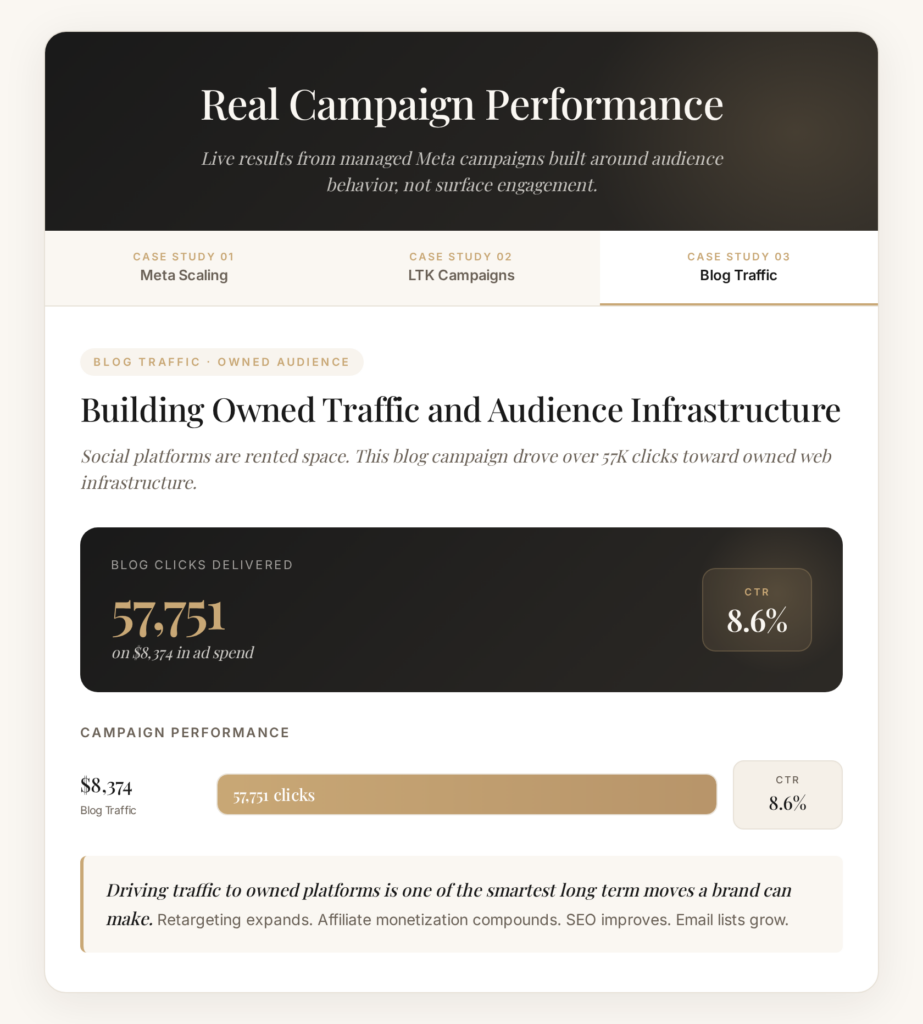
We have seen this repeatedly through traffic focused Meta campaigns. One LTK campaign managed through Parlay Collective generated more than 34,000 clicks from approximately $4,000 in ad spend while maintaining a click through rate above 10 percent. Another campaign scaled to over 65,000 clicks with approximately $9,500 in spend while maintaining strong traffic efficiency. These campaigns were not built around simply increasing engagement. They were built around driving intentional traffic toward monetizable platforms (LTK storefronts, Amazon storefronts, and affiliate links) where conversions could continue compounding beyond social media itself.
The same principle applies to blog traffic campaigns, which I personally think are becoming increasingly valuable as creators and brands focus more heavily on audience ownership. Social platforms are rented space. Algorithms can shift overnight, reach can decline instantly, and platforms ultimately control visibility. Blogs, websites, email lists, and customer data create much more stability long term because they allow businesses to build audiences they actually own instead of relying entirely on third party algorithms for discoverability.
One blog traffic campaign managed through Parlay Collective generated more than 57,000 clicks while maintaining strong click through performance at scale. What makes campaigns like this valuable is not simply the traffic itself. It is the long term infrastructure that traffic supports. Retargeting opportunities expand. Affiliate monetization increases. SEO improves. Audience data becomes stronger. Conversion tracking becomes more refined. The business begins building infrastructure that compounds instead of relying entirely on temporary social visibility spikes.
Customer Psychology Is What Most Agencies Miss
I also think one of the biggest differences between casually boosting posts and running real campaigns is understanding customer psychology deeply enough to create advertising that feels aligned with audience behavior instead of disruptive to it. Audiences are extremely aware of marketing now. They can immediately recognize when ads feel disconnected, overly corporate, or inauthentic. Particularly in creator driven industries, audiences respond far better to advertising that feels naturally integrated into lifestyle, storytelling, education, or problem solving.
That is why creative direction matters so much inside campaign strategy. Some audiences respond best to educational content. Others convert through aspirational storytelling, urgency based messaging, authority positioning, or relatable lifestyle integration. Understanding how a brand should communicate is just as important as understanding who the brand is targeting. Strong advertising does not feel random. It feels intentional, aligned, and psychologically aware of how consumers actually make purchasing decisions online. That is the layer most agencies skip entirely, and it is the layer that separates campaigns that perform from campaigns that flatline.
Boosted Posts Are Not Bad. They Are Just Misunderstood.
What most businesses eventually realize is that boosting posts may increase exposure temporarily, but exposure alone is not what creates sustainable scalability. As mentioned Sustainable growth comes from building systems around audience acquisition, conversion optimization, retargeting, analytics, and strategic distribution. The brands consistently growing online are rarely relying on luck or hoping the algorithm randomly performs in their favor. They are building structures designed to create predictable traffic, measurable conversions, and long term customer growth.
And honestly, once businesses begin understanding the operational depth behind successful Meta advertising, they stop looking at boosted posts as a true growth strategy and start viewing them for what they actually are: a small visibility tool inside a much larger marketing infrastructure.
Quick Breakdown: Boosting Posts vs. Meta Ad Campaigns
Boosting a Post
Boosting works best when your goal is visibility. It can help amplify content that is already performing well organically and increase reach, engagement, profile visits, and follower growth. It is typically most effective for awareness campaigns, launches, collaborations, or extending the lifespan of high performing content. However, boosting is still limited in targeting, optimization, retargeting, and conversion tracking, which makes it difficult to scale strategically long term.
Best for: visibility, engagement, follower growth, awareness, and social proof.
Running a Meta Ad Campaign
Meta ad campaigns through Ads Manager are built around specific business objectives rather than surface level engagement. Campaigns can be optimized for conversions, affiliate traffic, lead generation, retargeting, website clicks, email growth, storefront traffic, and customer acquisition. This approach allows businesses to track audience behavior, refine targeting, optimize performance, and scale campaigns much more intentionally over time.
Best for: conversions, affiliate revenue, website traffic, LTK traffic, Amazon storefront traffic, email growth, scalable business growth, and retargeting.
The Campaign Playbook
A quick reference for matching the right format, offer, destination, and call to action to your campaign goal. Save this section, screenshot it, send it to your team. This is the formula behind every campaign worth running.

Strategy Is the Only Thing That Scales
There is so much nuance behind marketing, advertising, audience behavior, and brand growth that often is not talked about openly enough. I truly love helping others better understand how to capitalize on what is already working instead of constantly feeling like they are chasing the algorithm.
Boosting a post buys you visibility. Running a structured campaign builds you a business. Visibility fluctuates. Infrastructure compounds.
When the industry average for Meta ads sits at 1.86 percent CTR and the brands we manage consistently run between 8 and 11 percent, the difference is not coming from luck, virality, or a lucky piece of creative. It is coming from systems, and systems are the only thing that makes growth predictable.


As always, I hope my insight helps you navigate your business with more clarity, strategy, and confidence as you continue building and scaling your brand online. One of my favorite parts of this space is being able to share real experiences, real data, and real perspective with fellow entrepreneurs, business owners, and content creators who are trying to grow intentionally in such a fast moving digital landscape.
For more business insights, creator strategy, marketing conversations, and entrepreneurial tips, make sure to explore some of my latest blog posts below. Your support, your readership, and simply you being here genuinely means more to me than you know, and I am incredibly grateful for the community we continue building together every day.
Some Other Blog Posts You May Find Helpful: The Systems That Support How I Lead My Business Every Day, Maximize Your Reach with Google My Business Profile and Posting, The Rise of ShopMy: Features and Insights For Creators and Brands, The Most Effective Brand Collaboration My 2025 Guide For Brands and Influencers, Founder’s Favorites, Comparing Monetization Platforms: LikeToKnowit, Collective Voice, Mavely, Shop My, Amazon Influencer Program, & More
To stay in the know in real time, follow me on Instagram | Facebook | TikTok
You can always shop my favorite looks by following me at LTK | or My Amazon Store Front
READY TO SCALE?
Ready to Run Ads That Actually Scale?
If you are tired of boosting posts and hoping for results, let us talk about what structured ad management can do for your business. Parlay Collective specializes in building campaigns that hit 5x the industry average and hold that performance as you scale.
Book a Strategy Call · Learn About Our Ad Management Services
Statistics referenced from: WordStream Facebook Ads Benchmarks 2026, LocaliQ Facebook Advertising Benchmarks 2026, Triple Whale Facebook Ad Benchmarks by Industry, and Focus Digital CTR Benchmarks Report. Parlay Collective campaign data based on actual managed account performance.
Leave a Reply

YOU CAN ALSO FIND ME HERE
Let's get to know one another

I’m the Founder and CEO of Parlay Collective, where I oversee strategy, growth, and platform performance across brands and creator-led businesses.
My work centers on building strong online foundations through structure, clear execution, and a deep understanding of what drives conversion, return on investment, and sustained relevance. The perspective I share here comes from experience, scale, and long-term thinking.
Alongside this work, I share the realities of modern founder life, from corporate workwear, travel, and office life to the tools and considerations that support showing up prepared in demanding environments.
This platform reflects how I build today, focusing first on what works, then on how it shows up in real life.